Who Is Tahlequah?
- her scientific identification is J35
- she belongs to J Pod
- she is part of the endangered Southern Resident killer whale population
Southern Residents live in close matrilineal family groups, and individuals generally remain with their mothers and family throughout their lives.
Tahlequah’s 2018 Calf
Tahlequah/J35 carried her dead newborn for about 17 days in 2018, and she was again observed carrying a deceased newborn on December 31, 2024, continuing into January 2025
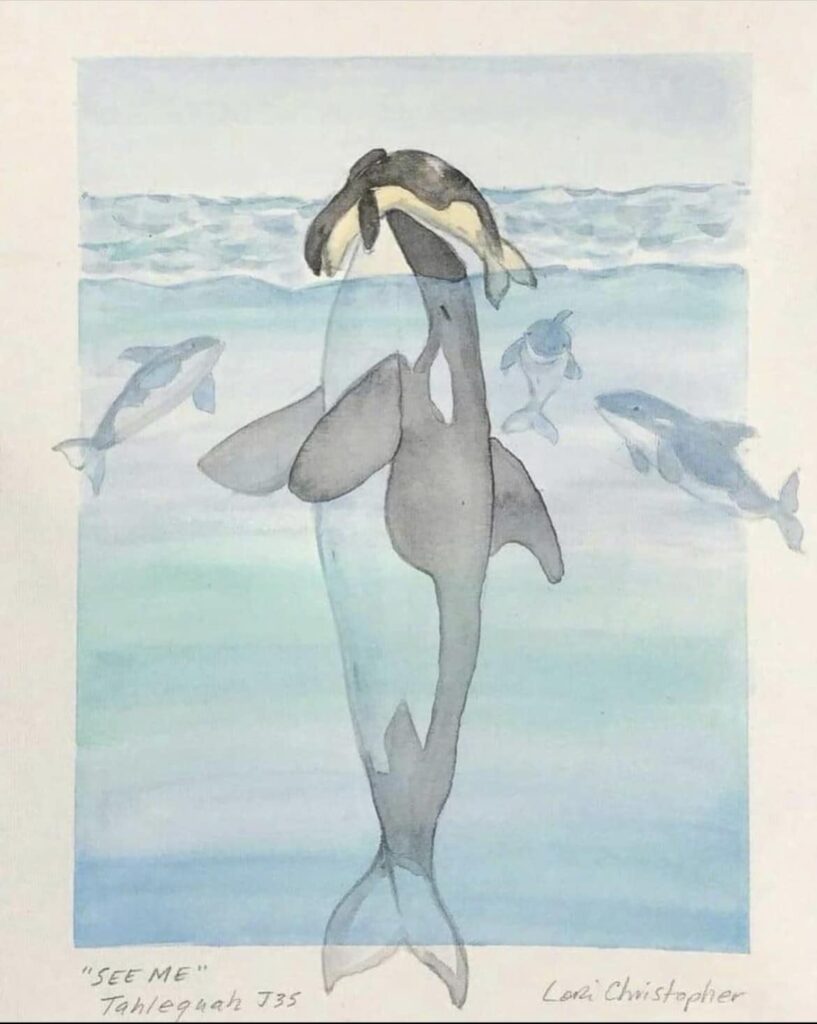
Tahlequah, also known as J35, is a female Southern Resident killer whale whose extraordinary display of grief captured worldwide attention.
On July 24, 2018, Tahlequah gave birth to a female calf that died shortly after birth. Instead of immediately leaving her calf behind, Tahlequah repeatedly supported and pushed the body through the waters of the Salish Sea.
She continued carrying her calf for approximately 17 days, traveling roughly 1,000 miles before finally letting her go. Her behavior touched millions of people and became one of the most widely known examples of apparent mourning observed in a wild animal.
Why Did Tahlequah Carry Her Calf?
Tahlequah’s behavior has widely been interpreted as mourning or grief. Killer whales have exceptionally strong social and family bonds, and researchers have documented similar responses to dead companions in cetaceans and other highly social mammals.
A magnificent killer whale named Tahlequah gave birth and caught the world’s attention. Her calf died only thirty minutes after being born, each of those blessed minutes a sacrament to the progeny of love.
The real reason journalists, photographers and millions of viewers followed this mother’s story, was her willingness to grieve unbidden, to become a thing utterly governed by kinship.
After a year and a half of growing this enormous life inside of her belly, and the immense feat of labor, and a half an hour of looking into one another’s eyes. Tahlequah proceeded to carry her dead baby on the tip of her nose for seventeen days. Traveling more than a thousand miles, all throughout the Salish Sea.
Some people think that grief is not inexplicably beautiful. Perhaps it’s because those people (who are us people) no longer see grieving enacted publicly, as a plea for sanity, as a way of feeding that which grants us life.
There was no real grieving at my mother’s funeral––sniffling and shoving tears back up into our eyes, yes, but no keening. No collapsing into the bottomless cavern of one another’s trembling arms, no crying out into the insufferable heat of that late-summer day. Certainly no carrying my mom’s dead body as a holy procession all throughout the places she ever knew and loved.
So I continued to carry her mostly on my own. I wailed in the privacy of my own home long after the funeral was over, with only the hurting eyes of my husband to behold me––a kind of holding that was never meant to be done alone. I imagine that if killer whales were not endangered, Tahlequah would have swam those seventeen days with a grand procession of many other glistening, black and white giants all across the ocean.
Or perhaps she swam for one thousand miles to personify the loneliness of her grief in a world spiraling toward oblivion. Our savagery for not swimming alongside her; for taking pictures, for watching her exquisite ceremony on our little screens as if it were pure entertainment. As if that couldn’t be any one of us, carrying our dead children out into the dark and emptied streets.”
Tragically, Tahlequah experienced another loss years later.
Researchers observed J35 carrying another deceased newborn calf off West Seattle on December 31, 2024. NOAA reported that she was still carrying the calf when she was observed in Haro Strait on January 10, 2025.
Seeing Tahlequah go through another loss made her story even more heartbreaking for those who had followed her since 2018.
Tahlequah’s Surviving Calves
Tahlequah has also successfully raised calves. J47 was born in 2010, and J57, Phoenix, was born in September 2020. The Center for Whale Research documented J57 swimming vigorously beside her shortly after birth.
Why Southern Resident Orcas Are Endangered
Southern Resident killer whales are federally listed as endangered in the United States. Major concerns identified by NOAA include limited prey—particularly salmon—vessel noise/disturbance and environmental contaminants.
Tahlequah’s story became more than the story of one grieving mother. It brought worldwide attention to the difficulties faced by the entire Southern Resident population.
Her story touched me deeply because it showed something I have always believed: animals experience profound relationships with one another, and their emotional lives deserve our attention and respect.
Why Tahlequah’s Story Touched Me
Why animal emotions fascinate me
Animal emotions are fascinating because they show that many animals experience the world in ways that are far more complex than simple instinct. Animals can form strong social bonds, recognize individuals, seek comfort, protect companions, play, show fear, and change their behavior after the loss of a family member.
What makes this especially interesting is that animals cannot explain their feelings to us with words. We have to understand them through behavior, body language, vocalizations, social relationships, and changes in routine. Scientists therefore have to be careful not to assume an animal feels exactly what a human would feel, while still taking seriously the evidence that many species have rich emotional lives.
Highly social animals are especially compelling. Orcas, elephants, primates, wolves, dogs, and many birds form long-lasting relationships and depend heavily on their families or social groups. When those relationships change—through separation, reunion, birth, or death—the animals may respond in noticeable ways.
Tahlequah’s story is a powerful example. Her prolonged behavior after the death of her calf attracted worldwide attention because it looked strikingly similar to mourning. We cannot know precisely what she experienced internally, but her actions remind us that the bonds between animals can be deep and enduring.
Studying animal emotions also changes how we think about our responsibilities toward them. The more we understand about social attachment, fear, stress, comfort, and companionship, the better we can make decisions about animal welfare, conservation, captivity, and responsible pet care.
Perhaps the most fascinating part is that animal emotions can make the boundary between humans and other species feel much smaller. Their lives are different from ours, but their relationships can still reveal familiar themes: attachment, trust, companionship, loss, curiosity, and the desire to remain close to those who matter to them.
What humans can learn from animals
Animals can teach us a great deal about loyalty, patience, resilience, trust and the importance of relationships.
Many animals live very much in the present. They do not worry about status, possessions or appearances in the same way humans often do. Their lives are centered on survival, family, companionship, safety and the bonds they form with others.
Animals can also remind us how important it is to pay attention. A dog notices our moods. A goose watches over its flock. Wolves depend on cooperation. Orcas remain closely connected to their family groups. These relationships show how powerful trust and social bonds can be.
They also teach us about grief and loss. When animals change their behavior after losing a companion or offspring, it reminds us that attachment is not uniquely human. Tahlequah’s extraordinary behavior after the death of her calf made millions of people stop and consider just how deeply another species may experience loss.
Animals also demonstrate resilience. They adapt to changing environments, recover from difficult experiences and continue moving forward even when life is harsh.
Perhaps one of the greatest lessons animals can teach us is simply to value the lives around us. They remind us to appreciate companionship, protect those who depend on us, respect the natural world and recognize that humans are only one part of a much larger living community.
The more closely we observe animals, the more we realize that they are not simply creatures sharing our planet. They are individuals with relationships, behaviors and experiences of their own—and there is much we can learn by paying attention to them.
Artwork by Lori Christopher
More Remarkable Animal Stories
Romeo the Alaska Wolf
My Teacher Octopus
Sources & Further Reading
NOAA Fisheries — Southern Resident Killer Whales