If you have not seen this documentary on Netflix, and it’s available, I highly recommend watching this ! For those unfamiliar, My Octopus Teacher is a documentary (currently on Netflix) about a South African filmmaker. Craig forms an unlikely friendship with an octopus while swimming in the kelp forest near his home.
My Octopus Teacher is much more than a wildlife documentary. It is the story of an extraordinary encounter between a human and a wild octopus. A reminder that intelligence, individuality, curiosity, and perhaps even rich inner experiences are not limited to animals that resemble us.
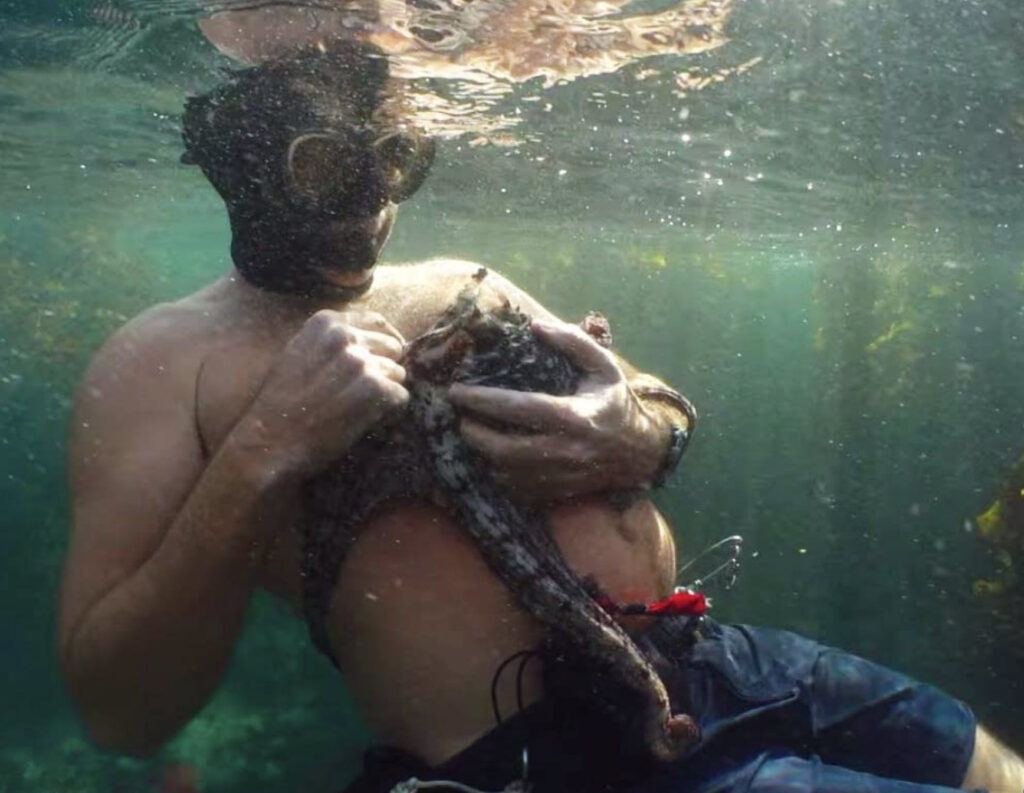
Towards the start of the film, Craig reflects on how he was overworked and burned out. He needed to reconnect with the wilds he knew in his childhood, to find himself again. By refocusing on green, he rediscovers his passion for film-making. His way of making the film takes on a green character both in means and in ends.
Foster’s journey to understand an octopus and himself — and the film that documents it — is indeed extraordinary. Viewers witness a man coping with exhaustion and burnout regain purpose by developing a relationship with an octopus off the tip of South Africa.
In 2018, Craig Foster began free-diving in a cold, underwater kelp forest at a remote location in False Bay, near Cape Town, South Africa. The location was near Simon’s Town on the Cape Peninsula, which is exposed to the cold Benguela current of the Atlantic Ocean. To make the film, Foster requires technology, but the film emphasizes how he minimizes the impact of that technology whenever possible.
Released in 2020, the documentary follows South African filmmaker and conservationist Craig Foster as he repeatedly dives into a kelp forest. There he encounters a wild female octopus whose life he begins observing closely. The Sea Change Project describes the film as following the year Foster spent with the animal in the Great African Seaforest, an enormous kelp ecosystem.
He chooses not to use scuba equipment or a wet suit because they would create barriers between him and the world he’s trying to capture. Craig wants to be more like an “amphibious creature” relying on its natural abilities. He learns to hold his breath for long periods of time. His goal is always to adapt himself to his environment, rather than the other way around.
What begins as observation gradually becomes something much more personal. The octopus becomes familiar with Foster’s presence, and their repeated encounters allow him—and the viewer—to see behaviors that challenge many traditional assumptions about invertebrate animals.
He started to document his experiences while free diving and, in time, met a curious young octopus that captured his attention. Craig started developing an intimate relationship with the octopus as he followed her for nearly a year. They form a bond where she plays with Craig and allows him into her world to see how she sleeps, lives, and eats. She frequently has to defend herself against pyjama sharks.
In one attack upon her, the octopus loses an arm, and retreats to her den to recover, slowly regenerating the arm over three months. In a later shark attack, she shows an incredibly improved creativity to survive, including sticking on the shark’s back.
Craig describes the effect of this mentorship-like relationship the octopus provided him, teaching him a lesson on the fragility of life and humanity’s connection with nature. This transfers to Foster creating a deeper bond with his son, Tom Foster, as his son develops as a diver and marine biology student.
Every day for a year, Foster went free diving without a wetsuit or scuba gear in the frigid ocean near Cape Town, with water temperatures as cold as 46 degrees Fahrenheit, to visit an octopus. He wanted to be “more like an amphibious animal” without barriers between himself and the marine environment. Watching trust build over time between a man and a curious, creative octopus referred to only as “her” — Foster never named her because “she was not a pet and I respect her wildness,”.
Pippa Ehrlich, director and editor of “My Octopus Teacher” and a member of the Sea Change Project. A nonprofit dedicated to connecting human beings to the wild and protecting the Great African Sea Forest, had never directed a feature-length film when she signed on to direct in March of 2017. She was so passionate about the project that she quit her job to work on the documentary.
Ehrlich had already “fallen in love” with the kelp forest while free diving every day for about six months before Foster approached her with footage that he and cinematographer Roger Horrocks had taken of his experiences with the octopus. They’d mainly been interested in capturing images of the octopus, rather than Foster’s relationship with her.
Since Ehrlich’s body had already adapted to diving without a wetsuit in cold water, she was ready to help shape the storytelling by getting shots of Foster swimming through kelp forests and looking into holes in addition to interviews and views from land. The process of additional filming and editing took three years. Much of the work above ground took place reviewing footage in Foster’s attic.
“Sometimes we worked for 18 hours a day,” she said. “Often we’d edit for six hours, go and shoot for three hours, and then come back and edit some more. We were so excited about what we’d got while we were in the water.”
Meeting an Extraordinary Animal
Octopuses can seem almost alien compared with mammals and birds.
They have no bones, eight highly flexible arms, remarkable skin capable of rapidly changing appearance, and a nervous system organized very differently from our own. Their evolutionary path separated from that of vertebrates hundreds of millions of years ago. Yet they developed sophisticated abilities to learn, explore, remember, hide, hunt, and solve problems.
In My Octopus Teacher, Foster does not simply encounter an octopus once and move on. He returns to her habitat repeatedly, gradually learning to recognize signs of her movements, hunting behavior, hiding places, and responses to danger.
Netflix describes the documentary as the story of a filmmaker forming an unusual relationship with an octopus in a South African kelp forest and learning about her world through their encounters.
That repeated observation is one of the reasons the story is so powerful. Instead of presenting an octopus as simply another member of a species, the documentary allows us to follow one individual animal.
And individuality matters.
Octopuses Are Remarkably Intelligent
Long before My Octopus Teacher became popular, scientists were studying the impressive cognitive abilities of octopuses.
Laboratory studies have demonstrated that octopuses can learn tasks, remember information, solve problems, navigate environments, and alter their behavior when circumstances change. In one experimental study involving a series of increasingly difficult puzzle tasks, octopuses learned how to manipulate objects through openings. Researchers concluded that the animals demonstrated significant behavioral flexibility.
Their nervous systems are also extraordinary. Research has estimated that some octopuses possess close to half a billion neurons distributed through a nervous system. It includes a central brain, large optic lobes, and extensive neural networks running through the arms. Scientists have documented sophisticated behaviors including learning, problem solving, discrimination, exploration, and highly advanced camouflage.
Their intelligence is especially fascinating because it evolved independently from the intelligence of mammals and birds. An octopus does not have to think exactly like a human, dog, dolphin, or chimpanzee in order to be intelligent.
It represents an entirely different evolutionary solution to the challenges of surviving in a complicated world.
The Incredible Art of Camouflage
One of the most unforgettable aspects of My Octopus Teacher is watching the octopus disappear into her surroundings.
Octopuses can rapidly alter the appearance of their skin, allowing them to blend with rocks, plants, sand, and other parts of their environment.
Camouflage is not simply beautiful to watch. It can be a matter of life and death.
For prey animals, remaining undetected or being mistaken for something inedible can significantly reduce the chances of being attacked by predators. Scientific research on camouflage describes strategies such as crypsis, in which an animal becomes difficult to detect. It masquerade, in which an animal resembles something else in its environment.
The octopus in the documentary combines camouflage with extraordinary body control. She can squeeze through tiny spaces, hide among shells and rocks, change her posture, and use the surrounding environment to make herself difficult to locate.
Watching these behaviors makes it difficult to think of an octopus as a simple creature operating only through rigid instinct.
She constantly responds to changing circumstances.
Intelligence Does Not Have to Look Human
Humans naturally recognize intelligence most easily when animals behave in ways that resemble us.
A chimpanzee using a tool, a dog understanding a command, or an elephant remembering another elephant feels familiar.
Octopus intelligence is different.
Much of an octopus’s nervous system extends throughout its body. Its arms contain extensive neural circuitry and can perform complicated sensory and motor tasks while coordinating with the rest of the animal.
Researchers studying octopus cognition have emphasized that these animals provide scientists with an opportunity to investigate a form of advanced learning and behavior, that evolved along a radically different evolutionary path from vertebrate intelligence.
That may be one of the greatest lessons of My Octopus Teacher.
We should not measure every animal’s mind by asking how closely it resembles our own.
There may be many different ways to be intelligent.
Can Octopuses Feel Emotions?
This is one of the most fascinating questions raised by the documentary—and one that deserves careful wording.
We cannot directly ask an octopus what she feels.
Scientists therefore examine behavior, nervous-system function, learning, responses to injury, motivation, preference, avoidance, and many other forms of evidence when considering whether animals are capable of subjective experiences.
Scientific interest in cephalopod sentience has grown considerably. Reviews of available evidence have concluded that cephalopods should be taken seriously as potentially sentient animals, and the United Kingdom formally recognized cephalopod molluscs—including octopuses—as sentient under its animal-welfare framework.
That does not mean scientists can say that an octopus experiences love, friendship, fear, curiosity, pleasure, or grief exactly as humans do.
Those are much harder questions.
But it also means we should be cautious about assuming that an animal experiences nothing simply because its brain and body are very different from ours.
The most scientifically responsible position lies somewhere between those extremes: observe carefully, remain curious, and avoid assuming either that animals feel exactly as humans do or that they have no meaningful experiences at all.
Trust Between Two Very Different Species
One of the most moving elements of My Octopus Teacher is the gradual change in the octopus’s behavior toward Foster. Rather than immediately touching or interfering with her, Foster spends considerable time observing her. Repeated encounters eventually lead to closer interactions.
What exactly the octopus understood about Foster is impossible for us to know with certainty. Calling the relationship a human-style friendship may therefore go beyond what science can demonstrate. But something observable did happen: the octopus became increasingly willing to interact with a large animal that initially represented a potential threat.
That alone is remarkable. It demonstrates how patience and repeated non-threatening encounters can reveal behaviors that might never appear during a brief wildlife encounter.
A Life Filled With Danger
The documentary does not romanticize life in the ocean as completely peaceful. The octopus lives in a world filled with predators. She must hunt while simultaneously avoiding being hunted. Some of the documentary’s most dramatic moments involve encounters with sharks. The octopus relies on camouflage, hiding places, agility, and unusual defensive strategies to survive.
These scenes illustrate something important about animal intelligence. Intelligence does not evolve simply to impress us. For a wild animal, remembering where to hide, identifying danger, finding food, choosing when to flee, and responding creatively to an unexpected threat can determine whether that animal survives another day.
An Entire Life in a Short Time
Perhaps the most emotionally difficult part of the story is realizing how brief the life of an individual octopus can be. The Sea Change Project describes the documentary as an unusual record of an individual wild animal across her life and notes that the central story was filmed over approximately a year.
Watching an individual animal across such a large portion of her life changes the experience. She is no longer simply an octopus. Viewers begin recognizing her behavior, watching her overcome challenges, and becoming invested in what happens to her. That experience mirrors something many people who spend substantial time observing wildlife eventually discover:
Once you recognize animals as individuals, the natural world begins to look different.
What Animals Can Teach Us
Animals do not have to speak our language to teach us something. Sometimes the lesson comes from simply paying attention.
My Octopus Teacher encourages viewers to slow down and observe rather than constantly interfere. Foster’s experience illustrates how much detail can remain invisible when we move through nature too quickly. One animal can reveal an entire world.
A rock becomes a hiding place. A patch of kelp becomes a hunting ground. A collection of shells becomes protection. Tracks, movements, textures, and tiny changes suddenly become meaningful. The documentary suggests that developing a connection with nature begins with learning how to notice it.
Why Animal Emotions Are So Fascinating
Humans have spent centuries debating where the boundary lies between instinct and thought, reaction and emotion, or simple behavior and conscious experience. Modern animal-behavior research continues to challenge simplistic answers.
Scientists have documented learning, memory, personalities, play-like behavior, problem solving, flexible decision-making, and other complex abilities across many animal groups once considered incapable of sophisticated cognition.
Octopuses are particularly important because their minds evolved so differently from ours.
If an animal with a radically different nervous system can solve problems, remember experiences, explore its environment, make decisions, and display individual patterns of behavior, then intelligence may be far more diverse than humans once imagined.
That realization does not require us to pretend animals are human. In fact, appreciating them for what they actually are may be even more extraordinary.
A Different Way of Looking at Wildlife
One of the greatest lessons of My Octopus Teacher is not simply that octopuses are intelligent. It is that attention changes our relationship with animals. When wildlife is viewed only from a distance, animals can become categories: octopus, wolf, whale, duck, elephant.
Spend enough time observing one individual, however, and differences begin to appear. One animal may be bold while another is cautious. One investigates something unfamiliar while another retreats. Individuals develop histories, preferences, strategies, and experiences.
Scientific research continues to explore exactly how complex these differences are, but the broader lesson remains valuable. Animals are not scenery. They are participants in the ecosystems around us.
What My Octopus Teacher Ultimately Teaches Us
The documentary won the Academy Award for Best Documentary Feature at the 93rd Academy Awards in 2021, with Pippa Ehrlich, James Reed, and Craig Foster receiving the award. Its lasting importance, however, may have less to do with the award and more to do with the questions it leaves behind.
How many intelligent animals do we overlook because their intelligence looks nothing like ours? How much animal behavior remains undiscovered because nobody has spent enough time watching? Can repeated encounters between humans and wildlife create recognition or trust? What does another animal experience when it looks back at us?
Science may eventually answer some of those questions. Others may remain mysteries. Perhaps that is part of what makes the octopus so fascinating. She reminds us that another mind does not have to resemble ours to deserve our curiosity and respect.
And sometimes the best way to understand another living creature is simply to watch, learn, and allow that animal to show us what its world is really like. Honestly if you haven’t watched it, I urge you too. You will not be disappointed if you love animals as much as I do. There is always something new to learn from them.